
This advice, often associated with David Bowie, has been in my mind recently. Whether expressed exactly in these words or not, Bowie repeatedly defended one principle: do not create for applause. The moment you optimize for approval, you stop innovating.

This post is first of all a self-reflection I want to share. A reminder to myself, before anything else.
We live in a world measured by likes, views, reactions, visibility. Slowly, without even noticing, we start adjusting our voice. We soften our opinions. We reduce disagreement. We choose what is safe instead of what is true.
We start playing to the gallery.
Psychology helps us understand why this can be dangerous.
I recently came across a review of the work on the Social Facilitation from Robert Zajonc.

Being completely unfamiliar with this field, I became curious. I learned that when we are observed, our level of arousal increases — meaning our nervous system becomes more activated. This activation can improve performance in simple or repetitive tasks, but it often reduces performance in complex, strategic, or creative ones.
Leadership is complex. It requires nuance, long-term thinking, and sometimes unpopular decisions. If we constantly feel observed or judged, our thinking becomes narrower. We choose safer options. We avoid friction. We perform instead of lead.
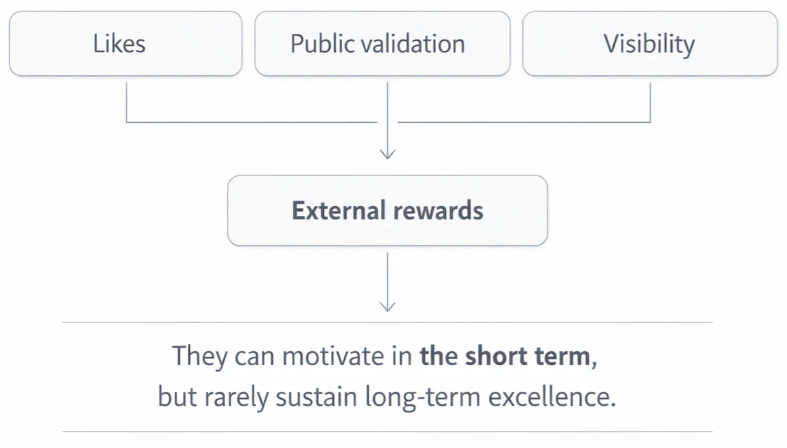
Another very interesting framework is the Self-Determination Theory developed by Edward Deci and Richard Ryan. This was also a domain where I had little knowledge before exploring it. Their research shows that sustainable motivation depends on autonomy, competence, and relatedness. When behavior is driven mainly by external rewards — approval, recognition, applause — intrinsic motivation decreases.
Solomon Asch demonstrated how easily individuals conform to group pressure, even when the group is objectively wrong. If this happens in laboratory experiments, imagine what happens in executive meetings. I believe many readers will recognize this pattern.
In project management, the implications are very concrete.
When we play to the gallery, we optimize dashboards for optics instead of clarity. We escalate to show activity instead of solving root causes. We prioritize consensus over correctness. We avoid difficult conversations to preserve popularity.
But leadership is not (only, and not necessarily) performance.
It is stewardship of value.
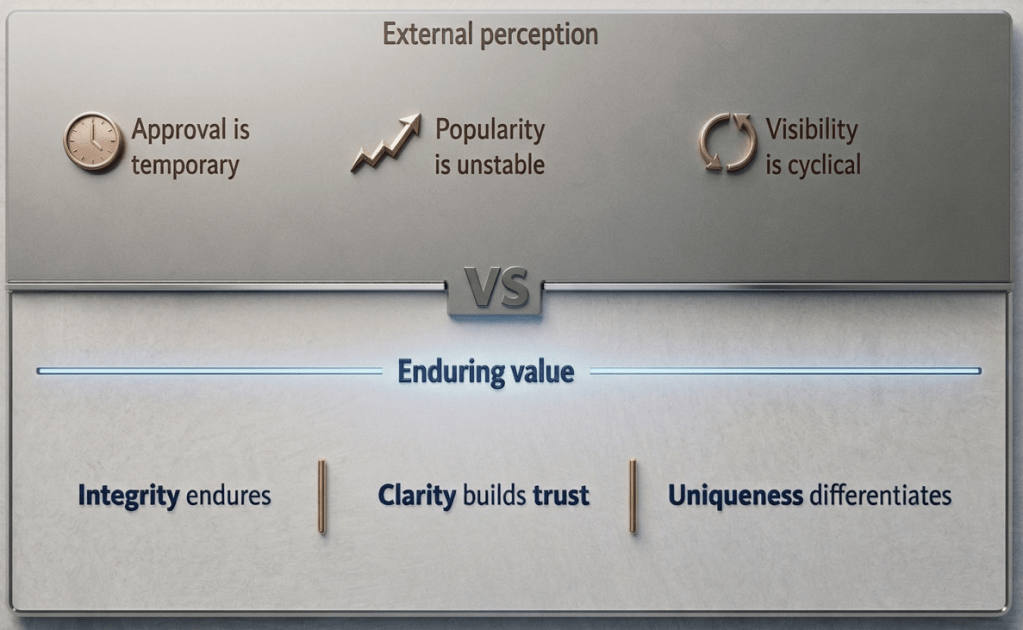
Research on authentic leadership shows that leaders grounded in internal values generate higher trust and engagement. Authenticity is not about being liked. It is about being coherent.
This reflection is not about rejecting feedback. It is about distinguishing feedback from dependence.
It is about asking: am I deciding based on value, or based on reaction?
In project management — at least in my experience — real impact begins when we stop performing for the room and start standing for something.
 ProjectAbility