
(The Role of Semiconductors in Data Growth)
When I talk to project managers from different industries and mention that I work in the semiconductor industry, I often notice a shift in their expressions—much like when someone encounters something intriguing but at the same time unfamiliar. This curiosity is usually followed by a series of questions.
So, to break the ice, I decided to start my first post to introduce to those who are not familiar with this domain, the industry that has shaped my entire career: the Nanotechnology Industry often referred as to as Semiconductor Industry.
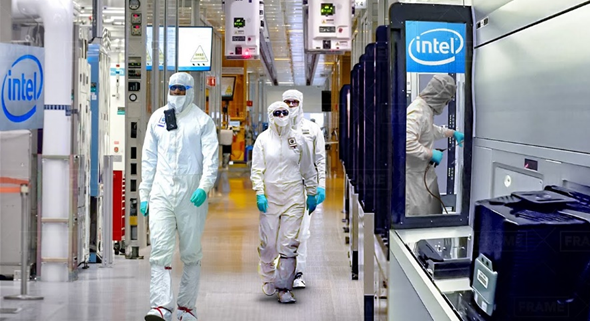
Before explaining what is the major driver of the industry I must make a short preface without necessary assuming that everyone is familiar with certain terminology..
What is it a semiconductor?

Semiconductors are materials that can act as either insulators (blocking the flow of electrons) or conductors (opposing negligible resistance to the electrons flow), depending on specific conditions. The modern electronics era began when we learned how to control these two states through precise processes. The most widely used substrate is obtained by a purification process of the Silice and if you are wondering why is so widely used…well. Because is massively present and relatively cheap..
There’s some debate about when the semiconductor era truly began. Some argue it was 1874, with the invention of the first integrated rectifier (AC-DC converter), while others point to 1947, when the first junction transistor was patented. Regardless of the exact date, the ability to control semiconductor properties was a breakthrough as transformative as the discovery of fire.
Moore’s Prediction and the Birth of a “Law”
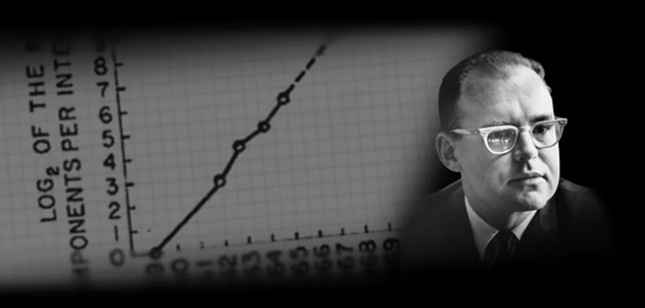
(credit INTEL website)
If you’re skeptical about my previous assessment, consider what happened less than 20 years after the first transistor was patented. In 1965, Gordon Moore, then Director of R&D at Fairchild Semiconductor, was asked to predict the future of semiconductor technology for Electronics magazine’s 35th-anniversary issue. His response? A short article titled “Cramming more components onto integrated circuits“, in which he observed:
“The complexity for minimum component costs has increased at a rate of roughly a factor of two per year… Over the short term, this rate can be expected to continue, if not increase. Over the longer term, the rate of increase is less certain, but there is no reason to believe it will not remain nearly constant for at least 10 years.“
Though not based on rigorous scientific validation, this observation quickly became a guiding principle—what we now call Moore’s Law. People of my generation have witnessed and experienced in real life the effect of Moore’s Law. Let’s observe, for instance, the number of transistors (a tiny integrated device that either switches electric current on and off generating the digital bits, or in other applications amplifies an electric current) integrated in a microprocessor, the heart of our PC.
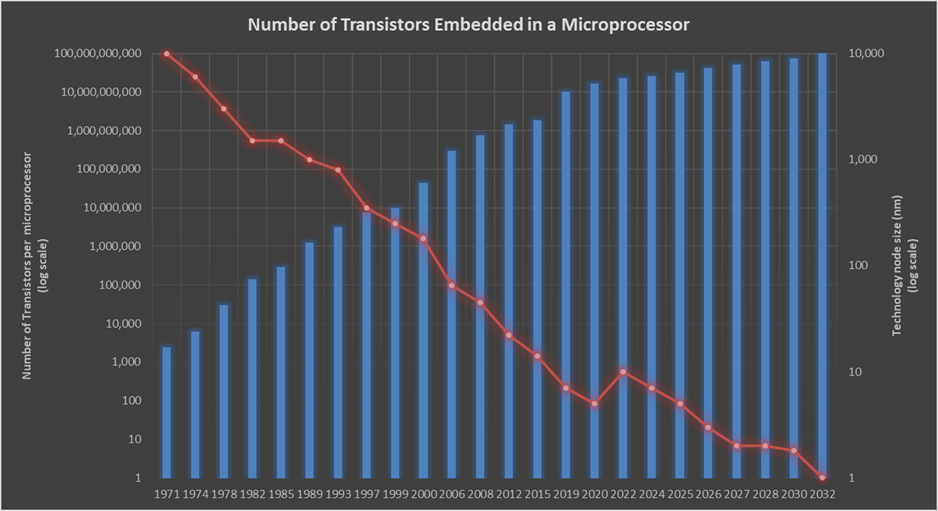
Trend of the number of transistors embedded in a microprocessor
Do you see how linearly correlated the two trend? In one side the number of transistors per microprocessor, while the other line shows the minimum feature size of the transistors and interconnects in the integrated circuit (IC).
All this preface was serving the purpose of explaining that what Semiconductor Industry does is constantly push the physical limits of the materials to enabling the achievements of smaller and smaller critical dimensions (CD).
Smaller CD –> Smaller Transistors –> More computational power/mm2
Smaller CD –> Smaller memory cells –> More storing capability/mm2

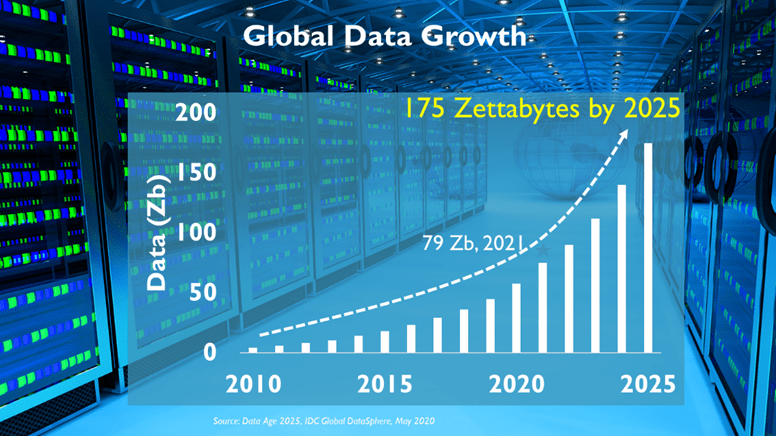
What is driving this constant need for more computational and storing power? The answer is one and simple… the NEED OF DATA!!!! IDC in 2020 predicted that the Global “Datasphere” will grow from 33 zettabytes in 2018 to 175 zettabytes by 2025 . What does it mean? It means that the world is moving toward more and more data-centric technologies and those data needs to be stored and processed. In the future we will witness an increment of data need which only the semiconductor industry can enable.
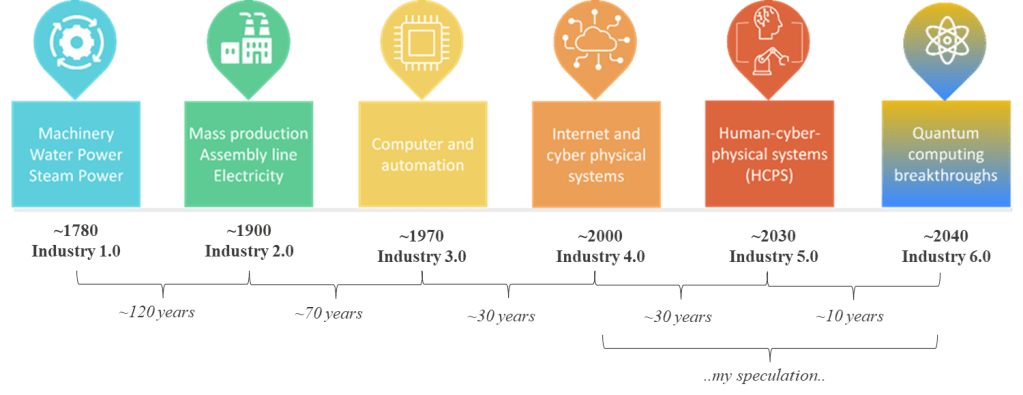
In conclusion, since its birth the semiconductor industry has gained pivotal importance in enabling the industrial revolutions. Nowadays, we are in full transition between the 4th and 5th industrial revolution, witnessing the fusion of digital, physical, and biological systems, leading to autonomous, interconnected, and intelligent industrial and huge transformations.
Article Word Cloud
References :
- Image courtesy of ww.tech-sparks.com and INTEL.com
- Industrial revolution trend image has been created by the author convoluting the various readings
- Intel and AMD Official Documentation: Product briefs, whitepapers, and technical specifications available on the companies’ websites.
- International Technology Roadmap for Semiconductors (ITRS): A comprehensive roadmap that outlines the industry’s goals and technology requirements for future semiconductor devices.
- Market Research Reports: Reports from firms like Gartner, IDC, and McKinsey provide insights into future industry trends and projections.
- Industry Conferences and Publications: Proceedings from conferences such as the International Solid-State Circuits Conference (ISSCC) and publications in journals like IEEE Transactions on Electron Devices.
- Industry 1.0 to 4.0: The Evolution of Smart Factories” by L. Ramya
- A Sequential Roadmap to Industry 6.0: Exploring Future Manufacturing Trends” by IET Journals
- Future of Industry 5.0 in Society: Human-Centric Solutions, Challenges, and Opportunities” by the Journal of Cloud Computing
#ProjectAbility
 ProjectAbility
good summary Paolo
LikeLike
Thanks for stopping by and for your feedback Salvo!
LikeLike